You Can’t Declutter Your Way Out of a Bad Closet Design
Many homeowners reach a point where they feel defeated by their closet. We donate bags of clothing, reorganize shelves, and promise ourselves to keep […]
January 26, 2026
Many homeowners reach a point where they feel defeated by their closet. We donate bags of clothing, reorganize shelves, and promise ourselves to keep things tidy. For a short while, the space looks better. Then daily life resumes, and the clutter returns. Shoes end up on the floor, clothes pile on chairs, and accessories disappear into drawers that never seem to work.
This cycle leads many people to believe they simply own too much. In reality, the real issue is often hidden in plain sight. A poorly designed closet will never stay organized, no matter how frequently we declutter. Without the proper structure, even a minimal wardrobe can feel chaotic.
Decluttering has become the default solution for nearly every storage challenge. It promises simplicity and control, and letting go of unused items can feel refreshing. We understand why so many homeowners start here. Clearing space creates immediate visual relief and a sense of progress.
The problem arises when decluttering becomes the only strategy. Removing items does not change how a closet functions. It does not create new storage zones, improve access, or correct poor layouts. Shelves remain too high, rods remain poorly placed, and important categories are still missing a proper home.
Imagine a closet with a single shelf and one hanging rod. Even after removing half the wardrobe, the imbalance remains. Folded items stack unevenly, long garments block shorter ones, and accessories have nowhere to go. The space may look tidy at first, but it quickly unravels as daily life resumes.
Closet organization problems are rarely caused by volume alone. They stem from layouts that do not support how we dress, store, and move through our routines. Without a system that naturally guides behavior, clutter always returns, no matter how often we declutter.
Bad closet layout issues show up in subtle ways. One long hanging rod forces everything into a single category. Deep shelves hide items behind one another. Drawers without dividers become catch-all spaces. Shoes stack on top of each other because there is nowhere else for them to go.
These design flaws make the organization feel like work. We constantly shift items around to access what we need. Clothes end up outside the closet simply because it is easier than putting them back. Over time, your space trains you to abandon good habits.
Even the most disciplined homeowner struggles to maintain order in a closet that lacks intention and clutter becomes inevitable.
Living with a closet that never stays organized affects more than storage. It adds stress to daily routines. Getting dressed becomes frustrating. You waste time searching for items you know you own. It becomes a reminder of unfinished projects rather than a supportive space.
This frustration often leads to extremes. You may feel pressured to purge repeatedly, even when you still need your stuff. Maybe you give up entirely and accept the mess as part of daily life. Neither option solves the underlying problem.
A closet should reduce stress, not create it. Without the right design, it does the opposite.
Custom closet design starts by understanding how we actually use our wardrobes. Instead of forcing habits into a generic structure, the design supports routines already in place. This shift changes everything.
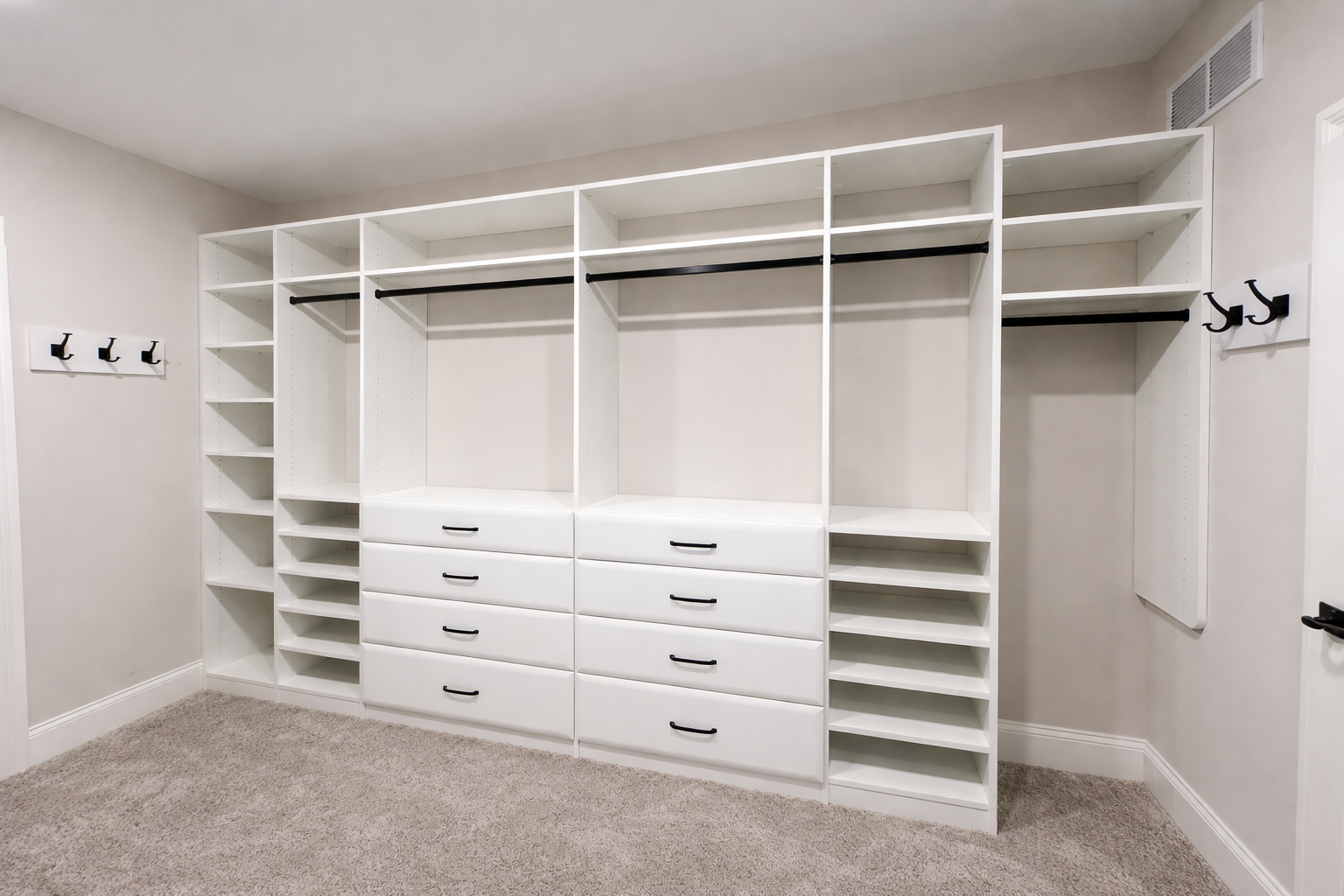
A well-planned closet divides space into clear zones. Hanging areas are sized for specific garment lengths. Shelving heights match folded items. Drawers are assigned purposes rather than becoming storage for anything that fits.
Adjustable components allow the space to evolve as needs change. Accessories are given dedicated locations so they do not migrate across the closet. Shoes are displayed or stored so that pairs remain visible and accessible.
This intentional structure removes the guesswork from organization. Putting items away becomes intuitive rather than exhausting.
Sustainable organization happens when the closet works with us, not against us. A custom layout anticipates how items enter and leave the space. It accounts for laundry cycles, seasonal changes, and daily routines.
For example, frequently worn items are placed within easy reach. Occasional pieces move higher or lower without becoming inaccessible. Drawers include dividers that prevent mixing categories. Shelves are spaced to avoid unstable stacks.
These details may seem small, but they shape behavior over time. When everything has a clear home, clutter has fewer opportunities to form. This level of planning cannot be achieved solely through decluttering. It requires thoughtful design and professional insight.
Materials and construction also influence organization. Weak shelves bow under weight, creating uneven surfaces that encourage messy stacks. Cheap hardware fails, leading to drawers that stick or fall out of alignment. These issues disrupt even the best intentions.
High-quality components maintain their shape and function over time. Smooth drawers invite use. Stable shelves support consistent organization. Durable finishes keep the space looking polished, which motivates upkeep.
A closet that feels solid and dependable reinforces good habits. We are more likely to care for a space that feels permanent and well-built.
Many homeowners believe staying organized requires ongoing effort. In reality, constant reorganization is a sign that the closet itself is not working. When a space is designed properly, organization becomes sustainable instead of exhausting.
True organization is not about owning less or endlessly purging. It is about having the right structure for what we own and how we live. A well-designed closet allows items to return to designated places naturally. Maintenance becomes simple. Seasonal changes require small adjustments rather than full resets, and the space continues to function even during busy weeks.
By shifting the focus from repeated cleanouts to thoughtful design, we remove the blame from ourselves and address the real problem. Custom closet design creates systems that support daily habits instead of fighting them. Decluttering still has value, but it becomes a supporting step rather than the primary solution.
When storage is intentional, the closet stops demanding constant attention and starts serving its purpose. Homeowners deserve organization that lasts and a space that works quietly in the background of everyday life.
If you are tired of decluttering only to watch the mess return, it may be time to rethink your closet design. Custom Storage Solutions specializes in creating closets that address poor closet layouts and support lasting organization. Our team designs spaces that align with daily habits and long-term needs. Contact Custom Storage Solutions to schedule a consultation and take the first step toward a closet that finally works the way it should.
Many homeowners reach a point where they feel defeated by their closet. We donate bags of clothing, reorganize shelves, and promise ourselves to keep […]